If you’re storing long, bulky, or awkward-shaped items like timber, pipes, steel bars, or furniture, standard pallet racking usually isn’t going to cut it. That’s where cantilever racking comes in. If you’re not sure what cantilever racking is, it’s built specifically for loads that don’t sit neatly on a pallet, and it’s a bit of a game changer once you’ve got the right setup.
The tricky part is deciding between single-sided and double-sided cantilever racking, since they look similar on paper but suit pretty different situations. Let’s go through the difference so you can work out which one actually fits your space.
Key takeaways
- Cantilever racking is designed for long or irregular loads that don’t work well on standard shelving.
- Single-sided cantilever racking is loaded from one side only and works well against a wall or in tighter spaces.
- Double-sided cantilever racking is loaded from both sides, giving you more storage in the middle of a warehouse floor.
- Heavy-duty cantilever racks can handle serious weight, so the right choice comes down to your load size, space, and how your team accesses stock.
- Getting the arm length, upright height, and base design right matters just as much as choosing single or double-sided.
What is cantilever racking?
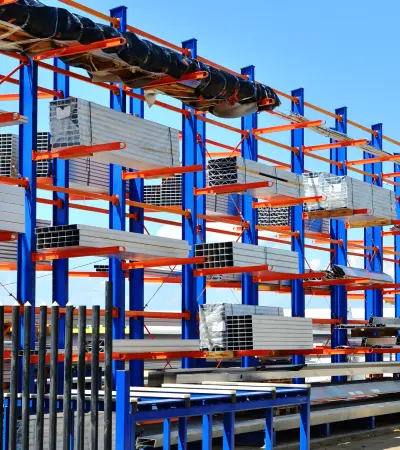
Cantilever racking is a storage system built around vertical columns with arms sticking out horizontally, rather than the boxed-in shelf structure you’d see with pallet racking. Because there are no front columns getting in the way, long items can simply be slid onto the arms and pulled off again without any obstruction.
This makes cantilever shelving a go-to option for businesses storing things like lumber, piping, furniture, or metal sheeting. It’s used a lot in timber yards, steel suppliers, and manufacturing warehouses, basically anywhere that standard cantilever racking systems and shelving units just aren’t practical for the shape of the stock.
Once you know cantilever racking is right for your business, the next question is which of the types of cantilever racking suits your warehouse better.
Single-sided cantilever racking
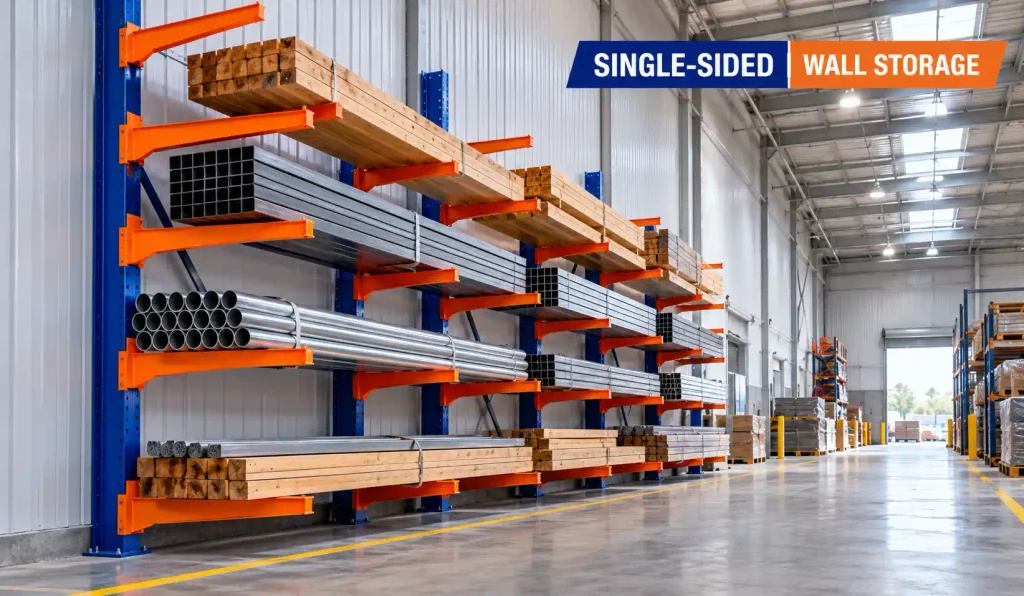
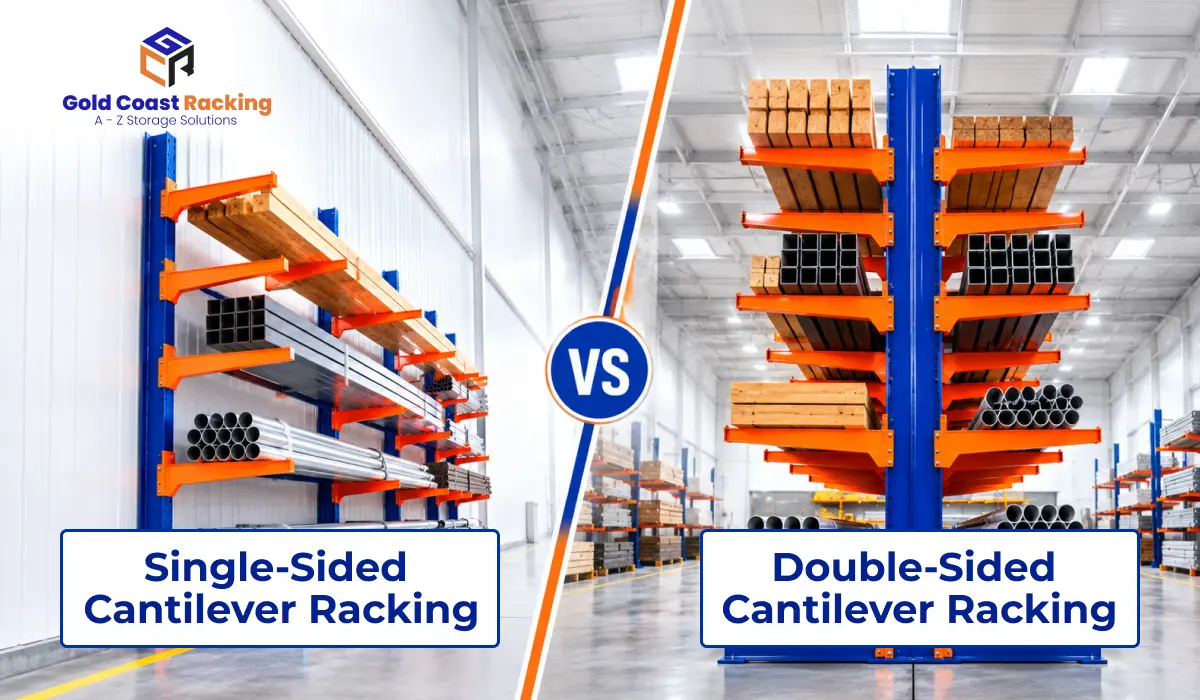
Single-sided cantilever racking has arms extending out from just one side of the upright, usually with the back of the frame sitting flush against a wall or a fixed structure.
Best suited for:
- Warehouses with limited floor space
- Storage set up against an existing wall
- Smaller operations that don’t need access from both sides
- Situations where forklifts only approach from one direction
Because you’re only building out in one direction, single-sided cantilever racking is a solid choice if you’re tight on space or want a simple, no-fuss setup that’s easy to install and maintain.
Double-sided cantilever racking
Double-sided cantilever racking has arms extending from both sides of the same upright, which means it can be loaded and accessed from either side. Instead of running racks along a wall, this style usually sits freestanding in the middle of your warehouse floor, with aisles on both sides.
Best suited for:
- Larger warehouses with open floor space
- High-volume storage where access speed matters
- Operations with forklift access from multiple directions
- Businesses wanting to maximise storage without adding more rows
Since you’re getting double the storage from the same set of uprights, double-sided cantilever racking tends to work out more cost-effective per square metre for bigger operations, as long as you’ve got the floor space to make use of it.
Single-sided vs double-sided: how to choose
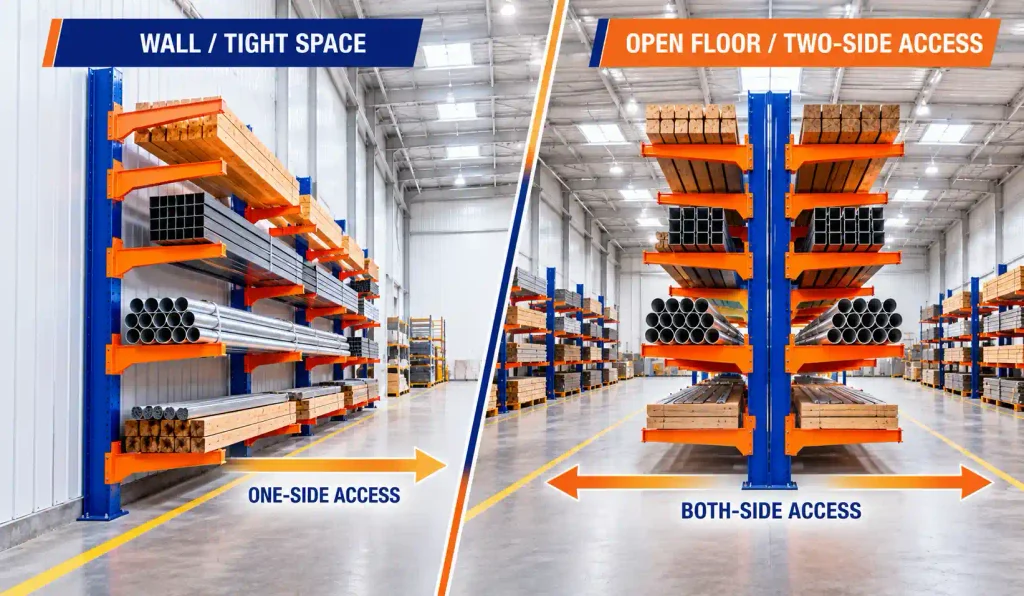
Here’s the simplest way to think about it: if your racking is going against a wall or you’re working with a narrow space, go single-sided. If you’ve got open floor space and want to store more without expanding your footprint, double-sided is usually the smarter option.
Here’s a quick side-by-side to make it easier to compare:
| Feature | Single-Sided Cantilever Racking | Double-Sided Cantilever Racking |
| Loading access | One side only | Both sides |
| Best for | Walls, narrow spaces, smaller setups | Open floor space, larger warehouses |
| Forklift access | Needed from one direction only | Needed from both directions |
| Storage efficiency | Lower per square metre | Higher per square metre |
| Typical placement | Against a wall or fixed structure | Freestanding, in the middle of the floor |
| Upfront cost | Generally lower | Generally higher |
| Expansion flexibility | Limited without extra rows | Easier to scale storage capacity |
| Common uses | Smaller timber yards, tighter storage areas | High-volume steel, timber, or pipe storage |
A few other things worth factoring in:
Load weight and type Whether you’re going single- or double-sided, heavy-duty cantilever racking is essential if you’re storing anything with real weight behind it, like steel bars or large timber lengths. Check the arm and upright load ratings before you commit to a system.
Forklift access: Think about how your team actually moves stock in and out. If forklifts only ever come from one side, there’s not much point paying for double-sided access you’ll never use.
Future growth: If there’s a chance you’ll need more storage down the track, double-sided cantilever racks give you more flexibility to expand without needing a completely new layout.
Installation and space planning Whichever way you go, proper spacing between uprights and correct base plate anchoring make a big difference to how stable and safe the whole system is over time. It’s worth following a proper guide on how to install cantilever racking safely rather than guessing your way through it.
Why the right cantilever racking system matters
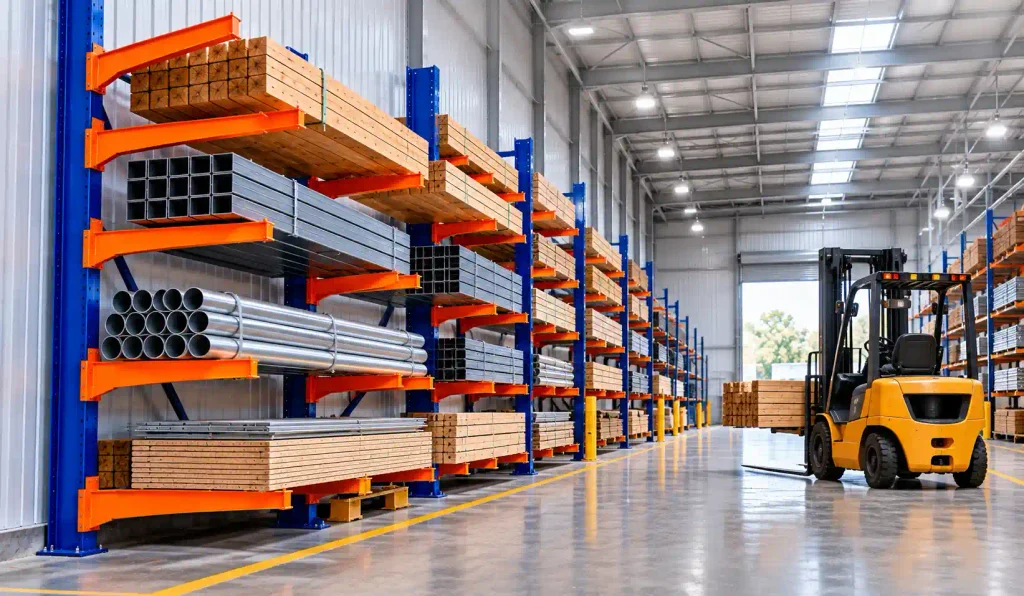
Getting this decision right isn’t just about saving space; it’s about running a safer, more efficient warehouse. Our full rundown of the benefits of cantilever racking goes into more detail, but in short, a well-matched cantilever racking system means:
- Long or awkward loads are stored securely instead of leaning against walls or stacked on the floor.
- Staff can access stock faster, without shifting other items out of the way first.
- Heavy-duty cantilever racks reduce the risk of damage to both the stock and the racking itself.
- You get better use of your available floor space, whether that’s a single row against a wall or a freestanding double-sided run
It’s also worth knowing how to use cantilever racking safely day to day, since even a well-installed system can become a hazard if it’s loaded or accessed the wrong way.
If you’re comparing cantilever racking for sale, it’s worth talking to a supplier who can look at your actual warehouse layout rather than just selling you a standard size. What works for one business storing steel pipe won’t necessarily suit another storing furniture or timber.
At Gold Coast Racking, we supply both single- and double-sided cantilever racking systems built to handle serious loads, along with the rest of our range across pallet racking, horse and cattle yards, and warehouse storage solutions. If you’re ready to buy cantilever racking in QLD, our team can help match the right setup to your space rather than a one-size-fits-all option.
Conclusion
Both single-sided and double-sided cantilever racking do the same basic job; they just suit different spaces and different ways of working. If you’re tight on a room or working against a wall, single-sided is the simpler option. If you’ve got open floor space and want to make the most of it, double-sided will usually give you better value.
Take the time to think about your load weight, your access points, and where your business might be headed before you decide. Getting it right the first time saves you from a costly reconfiguration later on.
Frequently Asked Questions
1. What’s the main difference between single-sided and double-sided cantilever racking?
Single-sided cantilever racking is loaded from one side only, usually against a wall, while double-sided cantilever racking is loaded from both sides and typically sits freestanding in open floor space.
2. Which is better for a small warehouse?
Single-sided cantilever racking usually works better in smaller or narrower spaces, since it takes up less width and can be set up against an existing wall.
3. Can cantilever racking handle heavy loads?
Yes, heavy-duty cantilever racking is designed specifically for long, heavy items like steel bars, timber, and piping, as long as the arms and uprights are rated for the load.
4. What is cantilever racking commonly used for?
Cantilever shelving is commonly used for storing long or irregular items such as timber, pipes, steel sheeting, and furniture that don’t suit standard pallet racking.
5. Is double-sided cantilever racking more expensive?
It can cost more upfront since it uses more arms, but double-sided cantilever racks often work out more cost-effective per square metre because you’re getting storage from both sides of the same structure.
6. Where can I buy cantilever racking for sale?
Look for a supplier who can assess your warehouse layout and load requirements rather than offering a generic size, so you end up with a system that actually fits your space.