
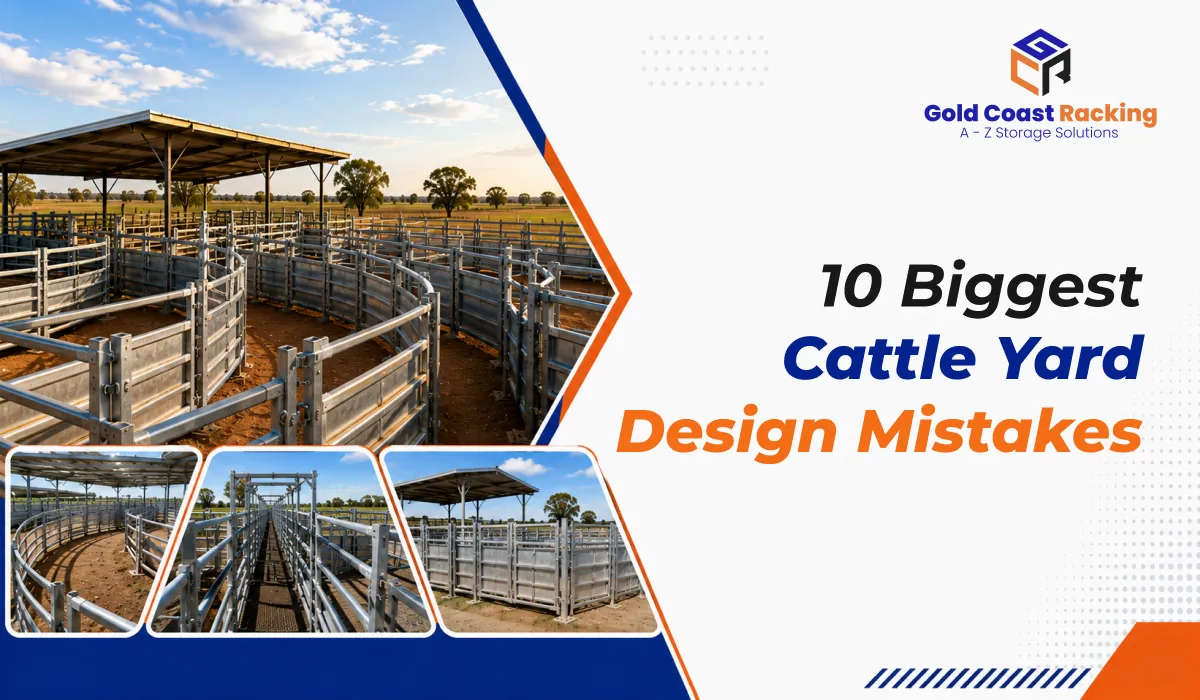
Setting up a cattle yard can be tricky. On one hand, you have to optimize the space you already have. And on the other hand, you need to make sure that your cattle get enough space too.
So, you need to invest in good equipment while also taking care of not exceeding your budgets.
All of these create a lot of confusion, eventually resulting in mistakes. Well, the easiest way to avoid them is to learn from the mistakes of others.
In this guide, we have put together the 10 most common mistakes first-time yard owners make. Don’t worry, we also explain how to avoid each one so you can build a safer and more efficient setup. For more planning tips, check out our Cattle Yard Guide. Let’s get right into it.
Key takeaways
- Choose your site carefully. Drainage, soil, wind, and sun orientation affect long-term yard usability.
- Design with cattle behavior in mind, using curved races and open sightlines to reduce stress.
- Prioritize handler safety with escape routes, non-slip flooring, and clear pathways throughout the yard.
- Invest in quality materials over cheap prices. Sturdy panels and gates prevent costly failures later.
- Plan gate numbers, operations, and future expansion carefully, and consult experts instead of designing alone.

1. Not giving enough thought to the location
You might know that assessing the site for cattle yard setup is a crucial step. But something that seems to always create confusion is not knowing what exactly to check about the location.
Before buying a cattle yard in qld and setting it up, make sure that:
1. There’s a slight slope for water drainage.
2. The soil is of the right type (doesn’t turn into mud-pits after rain).
3. There’s enough space for heavy vehicles to park and turn.
4. You have easy access to power and water.
How to avoid: Make a checklist of important factors as mentioned above and take a day or two to properly assess them.
2. Working against the natural cattle behavior
Keep in mind that cattle follow a natural behavior, and build your yard according to it. Following this in practice would mean avoiding corners and setting up curved forcing/holding yards.
An efficient cattle yard system makes cattle naturally move from a darker space into a lighter and open one. So, avoid any dimly lit alleys.
Another thing about cattle is that they won’t enter a place if there’s a dead-end in sight. So, make sure your forcing yard has enough open space.
How to avoid: While setting up the yard, think about your cattle’s convenience as much as possible. Double-check corners, dead-ends, lighting etc at every point.
3. Not taking into account the herd size
A cattle yard design for 20 50 100 head will differ a lot from a design for 200 or 300 head yards. And this differentiation is crucial.
Your herd size will decide what components (holding yards, forcing yards, race etc) should be included in your cattle yard layout. It also decides the size of each component.
Ideally, there should be a space of 1.8m2 per head so that cattle do not get agitated. Furthermore, try to keep room for easy expansions in future.
How to avoid: Do not try to cut on cost by skipping important space or components. Also, plan for the future expansions too.
4. Not building around multiple operations
Each task on the yard requires its own space and flow in the yard design.
Separating cattle would require drafting gates and multiple holding yards. On the other hand, the best cattle yard layout for livestock handling and their medical treatment consists of a robust head bail.
And if you plan on mixing two operations, give proper space to each of the tasks.
How to avoid it: Take into consideration all the important tasks (receiving, sorting, treating, loading) and do not get hyper-focused on any one operation.
5. Overlooking worker/handler safety
Leave spaces for the handler to guide the cattle from the outside. If it’s necessary for the handler to enter a yard, make sure there are easily accessible gates. Following Smart Cattle Yard Solutions can help improve livestock flow, handler safety, and overall yard efficiency.
Most cattle yard design and planning tips would also advise you to make sure the ground isn’t slippery due to mud or manure build-up.
How to avoid it: While planning the layout, map out the entire cattle flow as well as the handler’s role at each step. Then, build your yard around it.
6. Choosing equipment based on just prices
Do not go for cheap equipment. Panels and gates need to be of sturdy material while also fulfilling other criteria such as being non-corrosive and having smooth edges etc.
Look for powder-coated or galvanized or cattle panels that resists rust from years of weather and manure exposure. Moreover, the height of the panels, the width of the gates, and the rail spacing also matters a lot.
Refer to the cattle yard cost guide to get an idea of how to build an efficient yard at affordable prices.
How to avoid it: Buy from brands that have years of customer trust and best quality equipment at affordable prices.
7. Choosing the wrong number of gates
The gates should help remove the complexities of cattle movement, not add to it. Sharing cattle yard gates between yards creates bottlenecks which slows down the operations. On the other hand, too many gates result in confusion.
If you regularly draft cattle into 3+ groups, a single two-way gate setup forces extra handling and re-sorting.
How to avoid it: Place gates at natural decision points i.e. where cattle naturally need to be redirected.
8. Too narrow or too wide race selection
Often, where it all goes wrong in cattle yard design plans is the race. Either it’s so narrow that cattle become afraid to enter, or too wide that they start turning back.
A race should be wide enough with proper lighting that cattle can enter and see a clear space ahead of them. This keeps them calm. Also, do not make the mistake of building a straight race as it goes against natural cattle behavior.
How to avoid it: Keep the width of the race according to your cattle. Also, keep the sides solid so that they focus only on the way ahead.
9. Leaving corners throughout the yard
It’s easy to leave corners in the holding yard or forcing yard. But this is one of the most important mistakes to avoid when building a cattle yard.
That’s because cattle will huddle up and stop moving as soon as they spot a corner. Getting them to separate and start moving again will cost you an extra 15-20 minutes every time you need to get them through.
How to avoid it: Strictly follow a curved or semi-circular structure for your holding yard, forcing yard, or race.
10. Running a one-man show
While it is possible that you can do it all alone from planning to setting it up, it’s not free of risks.
You may know your way around cattle-handling, but cattle yard construction is a whole other task. Professionals know current NLIS requirements, workplace safety codes, and regional council/planning regulations that a DIY design might overlook.
Plus, having a second opinion never hurts. Experts at Gold Coast Racking would be more than happy to help you out by recommending the best design and flow.
How to avoid it: Do not back away from asking second opinions or hiring an expert team for the work.
Conclusion
Setting up a cattle yard for the first time can be confusing and result in mistakes. And you may not even realise you’ve committed a mistake until it’s too late.
Well, the simplest way to avoid them is to do your research about cattle behavior and the best practices to handle them. Moreover, an expert team may seem like an unnecessary cost but they can help you save your time as well as money in the long run.
So, follow this guide or hire someone and build your cattle yard system the correct way the first time around.
Frequently Asked Questions
1. What is the 20 50 100 head cattle yard design?
It’s a scaled layout sized for herd count, with pen, race, and crush where dimensions are adjusted to handle 20, 50, or 100 cattle efficiently.
2. What are the most common cattle yard design mistakes?
Poor location choice, ignoring cattle behavior, weak handler safety, wrong gate numbers, cheap materials, and designing alone without expert input.
3. How can I improve the layout of my cattle yard?
Use curved races, solid sides, proper drainage, and gates at natural decision points to improve cattle flow and handler efficiency.
4. What type of cattle yard panels should I use?
Choose galvanized or powder-coated steel panels with smooth welds, strong latches, and load-bearing strength suited to your herd size.
5. How do I make a cattle yard safer for livestock and handlers?
Add man-gates, catwalks, non-slip flooring, clear sightlines, proper lighting, and quick-release head bails for emergencies.
6. Why is cattle flow important in cattle yard design?
Good flow in custom cattle yard designs reduce stress, injury, and handling time by working with cattle’s natural behavior instead of forcing movement against instinct.
7. How often should a cattle yard be inspected and maintained?
Inspect gates, rails, and flooring every few months. Checking for rust, loose bolts, and wear before each mustering season.
8. What should I consider before building a cattle yard?
Consider location, drainage, herd size, cattle behavior, gate placement, material quality, handler safety, and future expansion needs.
