
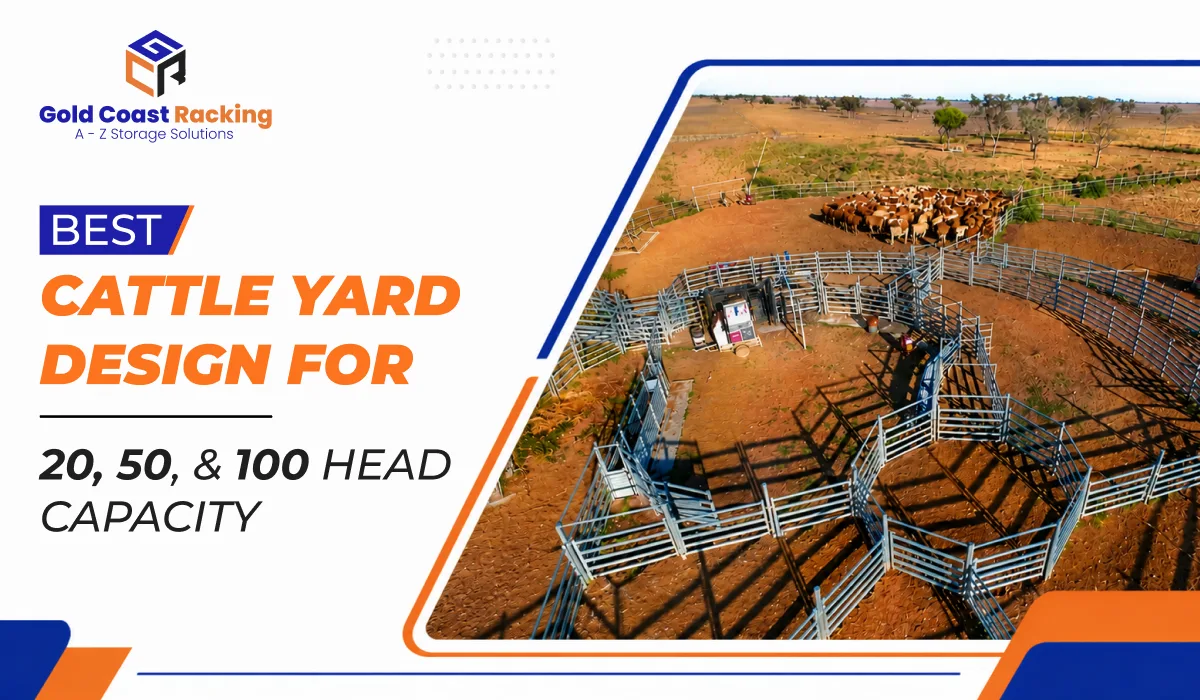
Setting up a cattle yard design as a beginner is not easy. What should be the size of the yard? What components should be included in it? And where should they be positioned? Your mind is full of these questions.
But a yard design doesn’t have to be so complicated, especially when you are dealing with a herd under 100 heads.
All you need is a detailed guide breaking down all the components of a yard design and suggesting you different designs according to your herd size. Read on to clear all your confusions:
Key Insights
- No single cattle yard design works perfectly for every farm and herd size.
- Every component of the solution (race, crush, forcing yard) must work together as one system.
- Curved races and solid panels work well with cattle behaviour instead of straight ones.
- Match your yard design to your herd size for smooth and stress-free operation.
- A well-designed yard saves time, reduces injuries, and makes handling significantly more efficient.

How to design the best cattle yard for efficiency
When designing a cattle yard, you have to keep in mind many factors. The design that provides the most efficiency is the one that helps your herd to remain calm and move smoothly from one end to the other.
And to make that happen, here are some tips that you should follow while installing a yard design:
- Evaluate your requirements
There is no one perfect cattle yard design out there. What works perfectly for one farm won’t necessarily work for yours.
That’s because there are multiple factors at play here such as your location, the task you want to perform, and the frequency of those tasks.
- Consider animal behavior
Cattle can become agitated, turn back, or and pile up in one place. To avoid all this, design your yard in a way that the animals can see a clear path ahead. This helps keep them calm and moving.
Also, make sure to build the yard in curves and do not include sharp turns in it. Buy cattle yards panels in Queensland that are sturdy enough to handle your herd.
- Make efficient use of all components
Make sure to use every component of your cattle yard setup the right way. Gates should be located near or along the fence lines and have a minimum width of 3m to safely handle up to 100 heads.
Furthermore, the holding yard should be circular in shape to keep cattle from bunching up in a corner. Along with that, the race should be of just enough width to let the animals pass through easily without turning back (ideally 7m).
Components of the best cattle yard designs
Before diving into the designs for your cattle yard, first it’s important to understand the function of each component that makes up the design.
It is not always necessary to use all of them in your smart cattle yard solutions. Hence, you need to understand what each one of them does and choose according to your requirements:
- Receiving yard
A receiving yard is an open area where your cattle is first kept after entering the yard design. With panels of height around 2m and a 2.2m area per head, this yard is designed to keep the cattle calm before guiding them into smaller areas.
- Holding yard
Many cattle yards in Queensland have holding yards which are smaller yards that are made to hold smaller groups of cattle before they are moved to pens or sorted/drafted. Although in smaller yard designs, the receiving yard also doubles as a holding yard.
- Race
Think of a race as a narrow corridor that leads your cattle to the crush or headbail one by one. It should be long enough for the animal to see clearly what’s ahead (around 7m) with a panel of 2-2.4m.
- Crush
Your entire cattle yard solution is built to guide the cattle towards the crush. For a herd under 100 heads, a crush consists of a headbail (a restraint mechanism that holds an animal by its neck) with at least 2m space in front of it for easy operator access.
- Loading ramp
A loading ramp is basically a ramp built for the specific purpose of loading and unloading cattle off a vehicle. These are installed in a cattle yard design if you require transportation of your livestock.
Best cattle yard design for 20 heads capacity
Your cattle yard doesn’t need to be of grand scale to hold 20 head of cattle. Rather, a small herd calls for a compact and simple set-up that is easy to manage even by a single operator.
Here’s what a 20 heads capacity cattle yard design should look like:
- A holding yard that provides around 1.8㎡ per head made up of 5 cattle panels of 2.1m height.
- A short crush consisting of 2 panels of 2.1m height, a head bail, and a sliding gate.
- A loading ramp situated in a split section near the crush for easy loading and unloading of cattle.
Best cattle yard layout for 50 heads capacity
A cattle yard to hold 50 animals needs more structure but can still be kept simple. With some limited components placed strategically, you can manage your herd efficiently.
Cattle Yard DesignHere’s what a 50 heads capacity cattle yard design should look like:
- A holding yard made up of 7 yard panels to ease your livestock into the yard design.
- A race of around 7-8m guiding animals towards the crush or the loading ramp.
- A short crush with a head bail and a sliding gate with a loading ramp that connects with the holding yard through another gate.
Ideal cattle yard design for 100 heads
100 heads capacity is where things get tricky. You need to have a yard design that is not too small that animals become agitated yet not too large that handling them becomes a hard task. But this can be easily navigated.
Here’s what a yard design to hold 100 animals should look like:
- 2-3 holding yards to comfortably hold your livestock in different groups.
- A semi-circular forcing yard situated in the middle of all the holding yards guiding animals towards a short race.
- Many cattle yards for sale in Queensland also include a crush at the end of the race with a head bail and a sliding gate.
- A loading ramp located at the end of the yard design that has gates from all the holding yards connected to it.
Conclusion
Your entire farm’s work flow depends on one thing – the design of your cattle yard. One lapse in the design can cause critical issues like long delays and serious injuries.
But don’t worry, there’s an easy way to avoid all these issues. Refer to this guide or simply book a free consultation call with Gold Coast Racking.
You can get guidance from our experts and set-up a yard solution that is perfect for your needs. Contact our experts now or visit our website to get readily available cattle yard solutions.
Frequently asked questions
1. What is the ideal cattle yard design for small herds?
A compact layout with one holding pen, a curved race, small forcing yard, and a crush works best.
2. How much space is required for 50 head cattle yard capacity?
Allow around 92㎡ for the holding pen, giving each animal roughly 1.8㎡of space.
3. What is the best layout for a 100 head cattle yard?
Multiple holding pens around a central sorting alley with a curved race and large forcing yard works best.
4. What materials are best for cattle yard panels?
Galvanised steel panels are most popular as they are strong, low-maintenance, weather-resistant, and handle heavy cattle pressure well.
5. How do I plan an efficient cattle yard design?
Map your cattle flow first, then position each component such as holding pen, forcing yard, race, and crush accordingly.
6. Are portable cattle yard panels a good option?
Yes, portable panels suit small herds well, offering flexibility to reconfigure your layout as your operation grows.
7. What safety factors should be considered in cattle yard design?
Ensure safe handler exit points, non-slip flooring, correct fence heights, and smooth cattle flow to minimise injury risk.
